
Pre-Qin Gold and Silver Artifacts: The Mysterious Sanxingdui Golden Scepter
Email SIYUNJO International at claire@siyunjo.com for product inquiries, quotations, and China sourcing services. We respond within 24 hours.
Pre-Qin Gold and Silver Artifacts: The Mysterious Sanxingdui Golden Scepter
In the fertile western Sichuan plain, Guanghan County, there is a village called “Sanxing” (Three Stars Village). To the south of the village flows the Mamu River, several dozen meters wide, winding gently from west to east. On its southern bank stand three yellow earth mounds rising above the ground, known as “Sanxingdui” (Three Star Mounds), arranged like three shining stars. On the northern bank lies a crescent-shaped terrain, narrow at both ends and broad in the middle, known as “Moon Bay.” The stars and moon face each other across the river, hence the beautiful name “Three Stars Accompanying the Moon.” This magical land was once the central capital of the ancient Shu Kingdom.
From Sacrificial Pits No. 1 and No. 2 at Sanxingdui, more than one hundred gold objects were unearthed, including a golden scepter, gold masks, gold foil, and ornaments in the shapes of tigers, fish, and circles. The quantity, size, and uniqueness of these artifacts are unparalleled in Shang–Zhou archaeology in China, bearing strong local characteristics and a pronounced religious significance.
The golden scepter is 142 cm long, 2.3 cm in diameter, and weighs 500 g. It was made of thick sheets of pure gold wrapped around a wooden core. The core had decayed, leaving behind carbonized traces. About 20 cm from the head of the scepter, a perforated bronze dragon-head ornament was found, serving as the finial (Figure 1). Near the top, a 46 cm section of engraved patterns is divided into three groups.
- The first and second groups are identical: two back-to-back fish above, and two back-to-back birds below. Between the fish heads and bird necks is a design resembling an ear of grain.
- The third group shows two human heads facing opposite directions. They wear high crowns with five prongs and triangular earrings. Around the heads are sets of parallel lines, separated by cloud-shaped motifs. These heads resemble the bronze standing figure of the Shu King found in Pit No. 2.
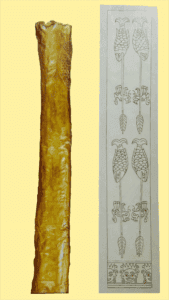
Figure 1. Sanxingdui Golden Scepter
Shang Dynasty. Formerly held at Sanxingdui Museum, Sichuan.
The imagery is deeply symbolic. The human heads represent the Shu King and authority; fish, diving deep into waters, and birds, soaring in the sky, symbolize the ability to traverse heaven and earth. The scepter thus served not only as a royal staff but also as a sacred instrument, mediating between deities and humankind. It signified the concentration of three powers in one: political authority, religious authority, and control of wealth. It embodied the supreme status of the ancient Shu rulers.
Several pure gold masks were also excavated from Pits No. 1 and No. 2. One bronze head sculpture from Pit No. 2—with thick brows, wide eyes, bulbous nose, tightly closed mouth, and cloud-patterned ears—was found tightly bonded to a gold mask with lacquer. Modern conservators had to use delicate dental tools to carefully separate the two.
The gold masks were hammered from sheets of pure gold. Their shapes correspond to the mysterious bronze heads, with cut-out eyes and eyebrows, a protruding nose, and ears decorated with thunder-cloud patterns. One mask measures 22 cm wide and 9 cm high (Figure 2).
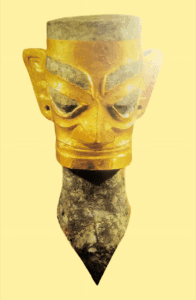
Figure 2. Sanxingdui Gold Mask
Shang Dynasty. Currently held at Sanxingdui Museum, Sichuan.
During the Shang and Zhou periods, a ritual dance known as Nuo was performed to ward off disease and evil. The Sanxingdui bronze heads wearing gold masks, with their hollowed eyes and brows, may have represented exorcist shamans—the so-called “Golden Four-Eyed” Fangxiangshi.
Inside another bronze head, a gold tiger ornament was discovered. Made from pressed gold foil, it measures 12 cm long, with a slender body, arched back, raised head, open mouth, extended front legs, crouched hind legs, and a curled tail, as if leaping forward. The tiger’s body is decorated with eye-shaped spots. This motif is common in early Shu culture and is considered a hallmark of its style.
Other gold finds include thin gold leaf pieces, shaped like elongated bamboo leaves, with finely engraved diagonal parallel lines suggesting leaf veins.
Gold, with its radiant color and natural durability, has always been revered as the supreme symbol of wealth, far more precious than bronze or jade, carefully preserved and rarely discarded. For this reason, gold artifacts are uncommon in archaeology. Yet in this small village on the Sichuan plain, the ruins of the ancient Shu kingdom yielded an astonishing number of pure gold objects dating back millennia. This speaks to the remarkable prosperity of Sanxingdui civilization. Still, a mystery remains: though never recorded in historical texts, this flourishing culture abruptly ended in the late Shang to early Zhou period.
Direct Contact
Email: claire@siyunjo.com
WhatsApp: +86 177 7786 7751
Response Time: Within 24 hours